
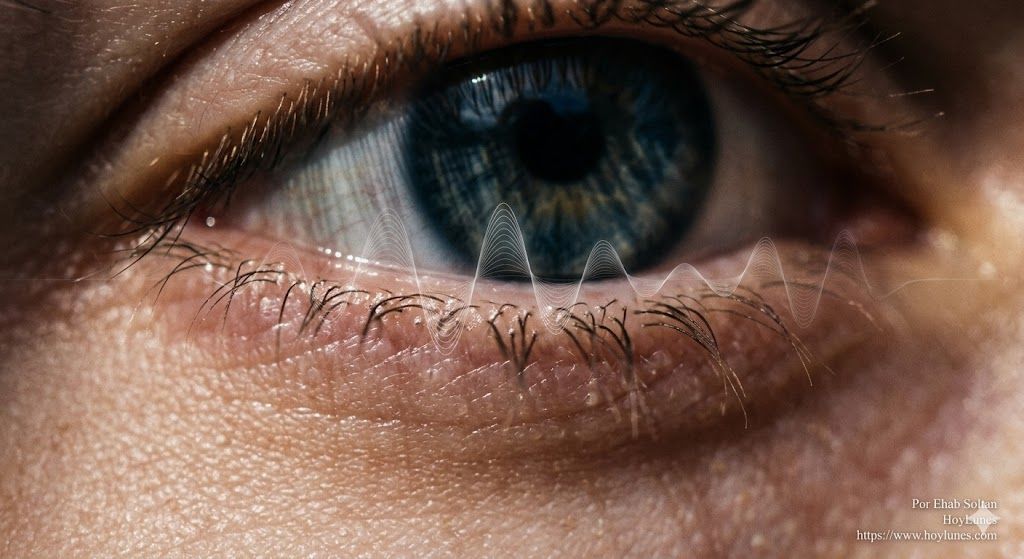
Why the loss of density and strength is not an aesthetic problem, but a signal of accumulated metabolic, hormonal, and behavioral stress.
By Ehab Soltan
HoyLunes — Imagine your body is a company in the middle of a financial crisis. What does the CEO do? They don’t cut back on the maintenance of the heart or the lungs; that would be the end. They cut the “decor and protocol” department. They stop painting the walls, cancel the flowers in the lobby, and turn off the ornamental lights.
This is exactly what happens every morning in front of the mirror. You notice your lashes are thinner, that the mascara that used to work wonders now seems to have nothing to hold onto, or you find a couple of tiny hairs on your pillow. Nothing hurts. You have no fever. But your biology’s “protocol department” has just received a budget cut: the body reduces investment in non-essential tissues to prioritize vital functions.
Your eyelashes are not failing: they are executing an energy-saving order.

The Traffic Light of Your Functional Health
There is a vital difference you must understand to stop feeling guilty and start feeling inspired by your own capacity for adaptation. Your eyelashes are not a direct indicator of clinical biomarkers (they won’t tell you if your blood sugar is high), but they are a direct functional indicator.
They act as a “whistleblower” for how you are managing your life; an interface between your internal balance and the external world. This happens because the growth cycle (anagen–telogen) is extremely sensitive to hormonal and energetic changes.
| If you notice… | Your body is saying… | The invisible factor | Alert level |
| Frequent shedding | “We are in survival mode.” | Sustained stress or nutritional deficit. The follicle shuts down to save protein and iron. | ⚠️ Medium |
| Fragility / Brittleness | “There is a silent fire here.” | Subclinical inflammation. Use of aggressive adhesives, unsuitable cosmetics, or friction. | ⚠️⚠️ High |
| Slow growth | “The factory is running at half speed.” | Metabolic fatigue. The organism prioritizes repairing vital organs during sleep. | ⚠️ Low |

The Paradox of Dynamic Biology: Women vs. Men
We often hear that the female hormonal system is “complicated”. It is time to change that narrative: the female system is dynamic and sensitive, which is an evolutionary advantage that requires a finer reading.
While the male metabolism tends to be more linear and stable, women operate in an environment of constant fluctuations (estrogen) that dictate the regeneration speed of peripheral tissues.
The cosmetic factor: It is not that makeup is “bad”, but the cumulative use of powerful makeup removers and mechanical curlers generates invisible cumulative microtrauma.
Nutritional sensitivity: The follicle is a devourer of amino acids. At the slightest shortage, the body diverts those resources toward the production of red blood cells, leaving the eyelash on a “waiting list”.
The Hourglass: From Infancy to 40
Age is not a curse; it is a change of pace. Understanding these stages allows you to adjust expectations:
Infancy (Golden Metabolism): Stable, thick lashes thanks to perfect efficiency, without hormonal interference or oxidative stress.
Youth (Regeneration Peak): Maximum growth where “anything goes”, but where structural damage is often sown through behavioral excesses.
The 40s (The Great Adjustment): This is where hormonal aging appears. The decrease in estrogen shortens the growth phase (anagen). Density decreases because the replacement cycle is slower: the “restock” simply doesn’t arrive in time.

The Conflict with the Industry: Does it Help or Cover Up?
The traditional cosmetic industry is obsessed with immediate volume, often at the expense of follicular health. Heavy extensions and permanent adhesives do not cause damage out of malice, but out of physics: mechanical traction and occlusion. It is like trying to make a plant grow by placing a stone on top of it.
The problem is not a one-time use, but the daily repetition of small aggressions that the eye does not see, but the follicle records. This has created a new market opportunity: follicular recovery systems based on diagnosis and respect for biological rhythm, instead of camouflage products.
The Awakening of the Gaze
Next time you are in front of the mirror and feel that your lashes “aren’t what they used to be”, don’t rush for the most expensive serum. First, take a pause.
That small gap or that lack of shine is an “internal email”. Perhaps it is asking for an extra hour of sleep, for you to check your iron levels, or to stop rubbing your eyes with the digital urgency that dominates us all.
Real self-care begins when you stop seeing an aesthetic defect and recognize a message of self-protection. Your lashes are the sentinels of your energy; before correcting them, listen to them. The most lasting beauty is the one that flourishes when the internal system decides that, finally, there is enough budget to shine again.
Because when the body feels safe again, it doesn’t just recover energy: it recovers the permission to show itself to the world.
Sources and Research Lines:
NIH: Mechanisms of the anagen and telogen phases in response to cortisol.
Cleveland Clinic: The impact of Allostatic Load on the hair follicle.
American Academy of Dermatology: Effects of mechanical traction on eyelid health.
Mayo Clinic: The role of estrogens in keratin synthesis.
#WomenHealth #HumanBiology #Longevity #FunctionalDermatology #HoyLunes #EhabSoltan #RealWellbeing